From Fear of Food to Health: Reva Agarwal’s Recovery Journey Story..
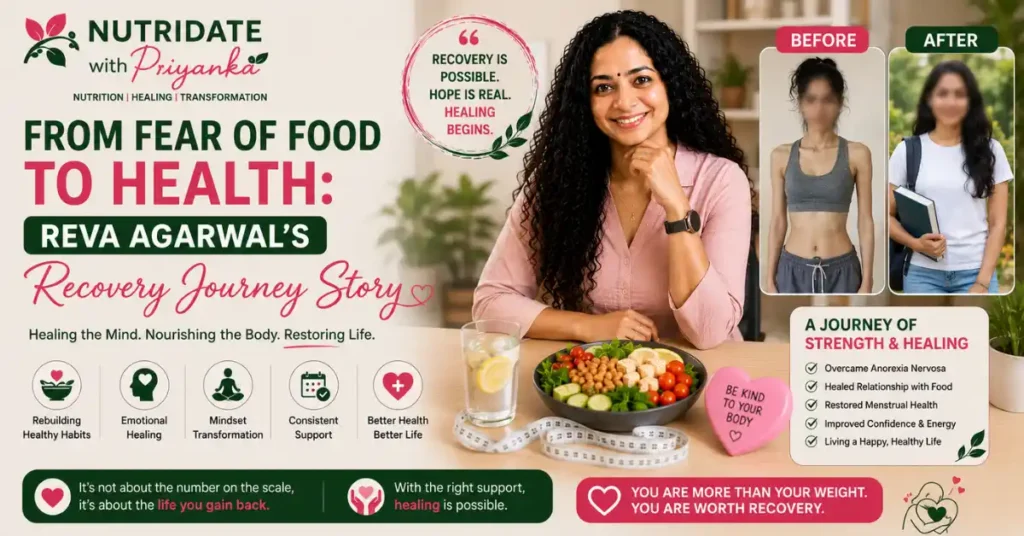
There are some cases that go far beyond weight loss or weight gain. They become journeys of rebuilding health, confidence, emotions, and life itself.
Reva Agarwal’s story is one such journey.
At just 22 years old, Reva was battling anorexia nervosa, one of the most serious eating disorders. Food had become her biggest fear. Every meal came with overwhelming guilt, anxiety, and emotional distress. Instead of nourishing her body, she constantly punished herself for eating.
When she came to me, the goal wasn’t simply to help her gain weight. The goal was to help her regain her health, restore her confidence, and rebuild her relationship with food.
This is her inspiring recovery journey.
Ready to Build a Healthier Relationship with Food?
Reva Agarwal’s inspiring journey from fear of food to better health shows that recovery is possible with the right nutrition, guidance, and sustainable lifestyle changes. If you’re struggling with restrictive eating, food anxiety, or maintaining a balanced diet, a personalized nutrition plan can help you regain confidence and improve your overall well-being.
Start Your Personalized Nutrition Journey TodayWhen the Body Starts Giving Warning Signs
Reva was referred to me by a leading gynaecologist after she had not experienced her menstrual cycle for almost a year.
Missing periods at a young age is often a sign that the body is not receiving enough nutrition. In Reva’s case, the underlying cause was severe anorexia nervosa.
Standing at 5 feet 7 inches tall, she had become extremely underweight and physically fragile. However, the biggest challenge was not her weight. It was her mindset.
She was terrified of food.
She refused to step on a weighing scale because the numbers created overwhelming anxiety.
Even eating a single slice of pizza would make her feel guilty enough to spend extra hours exercising. After eating something she considered unhealthy, she would often avoid food completely for the next 24 hours.
Her relationship with food had become controlled by fear instead of nourishment.
When the Situation Became Serious
The condition gradually became life-threatening.
During one such episode, Reva fainted because her body was no longer getting the nutrition it needed.
Her parents immediately travelled from India to the United States to bring her home and ensure she received proper medical care.
By then, she was already under the care of multiple healthcare professionals, including:
- A psychiatrist
- A psychologist
- A gynaecologist
- A dietitian
Eating disorders are complex medical conditions. They cannot be treated through diet alone. Recovery requires a multidisciplinary approach where medical treatment, psychological therapy, nutritional rehabilitation, and family support work together.
Understanding Anorexia Nervosa
Anorexia nervosa is much more than simply eating less.
It is a serious mental health condition where individuals develop an intense fear of gaining weight, even when they are dangerously underweight.
Common signs include:
- Extreme restriction of food intake
- Fear of weight gain
- Excessive exercise
- Distorted body image
- Missing menstrual cycles
- Constant fatigue
- Weak immunity
- Hair loss
- Poor sleep
- Digestive problems
- Depression and anxiety
Without timely treatment, anorexia can affect the heart, hormones, bones, fertility, digestive health, and even become life-threatening.
Building Trust Before Building Nutrition
The biggest challenge was not creating a diet chart.
The biggest challenge was earning Reva’s trust.
Recovery from anorexia cannot begin with forcing someone to eat large meals.
Instead, it starts with understanding their fears.
We designed a gradual nutrition plan that focused on:
Small, Comfortable Meals
Rather than overwhelming her with large portions, we introduced small meals throughout the day that felt manageable and less intimidating.
High-Protein Nutrition
Protein played an important role in rebuilding muscle mass, improving immunity, and supporting overall recovery.
Every meal was planned carefully according to her comfort level.
Gut Health Recovery
Months of severe food restriction had affected her digestion.
The digestive system also needs time to heal. Foods were introduced slowly to reduce discomfort and improve tolerance.
Sleep Restoration
Poor sleep was making both her physical recovery and emotional health worse.
Improving sleep became one of the most important milestones in her healing journey.
Emotional Support Every Day
Recovery didn’t happen only during clinic visits.
Since Reva was emotionally vulnerable, we stayed in regular touch with her mother, almost daily, to monitor her eating habits, emotional wellbeing, and progress.
Family involvement became one of the strongest pillars of her recovery.
Ready to Build a Healthier Relationship with Food?
Reva Agarwal’s inspiring journey from fear of food to better health shows that recovery is possible with the right nutrition, guidance, and sustainable lifestyle changes. If you’re struggling with restrictive eating, food anxiety, or maintaining a balanced diet, a personalized nutrition plan can help you regain confidence and improve your overall well-being.
Start Your Personalized Nutrition Journey TodayOne Important Rule: No Discussions About Weight
One of the first decisions we made was simple.
We completely avoided discussing numbers.
Reva was not encouraged to check her weight regularly.
There were no conversations focused on kilograms.
Instead, we celebrated meaningful signs of recovery such as:
- Better sleep
- Improved energy
- Reduced anxiety around food
- Healthier digestion
- Better mood
- Increased confidence
- Improved strength
- More regular eating patterns
Recovery became about health instead of numbers.
The Beautiful Changes That Followed
Healing never happens overnight.
It happens through hundreds of small victories.
Slowly, Reva started changing.
Her face regained its natural glow.
She began sleeping better.
Her digestion improved.
She started feeling stronger every week.
Her confidence slowly returned.
Most importantly, after almost a year, her menstrual cycle became regular again, showing that her body was finally receiving the nutrition it desperately needed.
These changes were much bigger than weight gain.
They represented life returning to normal.
A New Beginning
Today, several years later, Reva has resumed her studies and is living a healthy, happy, and fulfilling life.
She no longer lives in fear of food.
She understands nourishment.
She understands balance.
She understands that her body deserves kindness instead of punishment.
Her recovery is proof that even severe eating disorders can improve with the right combination of medical care, nutritional guidance, emotional support, patience, and family involvement.
What This Journey Teaches Us
Eating disorders are never about food alone.
They are deeply connected with mental health, self-esteem, emotions, stress, and body image.
Recovery takes time.
It requires compassion rather than criticism.
Support rather than pressure.
Progress rather than perfection.
Most importantly, it teaches us that our bodies deserve love, care, proper nutrition, adequate sleep, hydration, and patience.
When all these elements come together, remarkable healing becomes possible.
When Should You Seek Professional Help?
If you or someone close to you experiences any of the following, professional help should be sought as early as possible:
- Constant fear of gaining weight
- Avoiding meals regularly
- Excessive exercise after eating
- Rapid or severe weight loss
- Missing menstrual cycles
- Fainting episodes
- Extreme weakness
- Obsessive calorie counting
- Anxiety around food
- Distorted body image
Early intervention significantly improves recovery outcomes.
Final Message from Priyanka Shah
Every individual deserves to have a healthy relationship with food.
Your worth is never defined by a number on the weighing scale.
Real health is about strength, nourishment, confidence, emotional wellbeing, and living life without fear.
If you or your loved one is struggling with disordered eating or anorexia, remember that recovery is possible with the right guidance, patience, and compassionate care.
You don’t have to walk this journey alone.
Ready to Build a Healthier Relationship with Food?
Reva Agarwal’s inspiring journey from fear of food to better health shows that recovery is possible with the right nutrition, guidance, and sustainable lifestyle changes. If you’re struggling with restrictive eating, food anxiety, or maintaining a balanced diet, a personalized nutrition plan can help you regain confidence and improve your overall well-being.
Start Your Personalized Nutrition Journey TodayFrequently Asked Questions
Yes. With early diagnosis, nutritional rehabilitation, psychological therapy, medical supervision, and family support, many individuals recover successfully and live healthy lives.
Yes. Severe calorie restriction and low body weight can disrupt hormone production, leading to irregular or absent menstrual cycles (amenorrhea).
Proper nutrition helps restore muscle mass, hormone balance, immunity, digestive health, brain function, energy levels, and overall physical recovery.
No. While healthy weight restoration is important, recovery should focus on improving physical health, mental wellbeing, eating habits, confidence, and quality of life.
A qualified dietitian creates personalized meal plans, supports gradual nutritional rehabilitation, helps reduce fear around food, monitors recovery, and works closely with the medical team and family for long-term healing.