Foods for Brain Health: Best Foods for Memory and Focus in Adults
Your brain needs more than calories to function well. Every day, it relies on a steady supply of nutrients to support memory, concentration, learning, mood and normal brain function. This is why the foods you eat regularly can be an important part of maintaining brain health as you get older.
The best foods for brain health are not limited to one “superfood.” A balanced eating pattern that includes fatty fish, eggs, leafy green vegetables, berries, nuts, seeds, beans, whole grains, fruits and healthy fats can provide a wide range of nutrients that support overall health, including the brain.
However, food should not be viewed as a quick fix for memory problems. No single food has been proven to prevent dementia or guarantee better memory. Brain health is influenced by nutrition as well as physical activity, sleep, blood pressure, blood sugar, cholesterol, stress and other lifestyle factors.
The good news is that many brain-supportive foods are simple, affordable and easy to include in an everyday Indian diet.
Want to Support Better Memory and Brain Health Naturally?
The right foods can provide essential nutrients that support brain function, memory, focus, and overall cognitive health. Discover practical nutrition strategies and brain healthy foods that can easily be included in your daily diet, with expert guidance tailored to your health and lifestyle goals.
Get Your Personalized Nutrition ConsultationWhat Are the Best Foods for Brain Health?
The best foods for brain health are generally nutrient-dense whole or minimally processed foods that provide healthy fats, protein, fiber, vitamins, minerals and beneficial plant compounds.
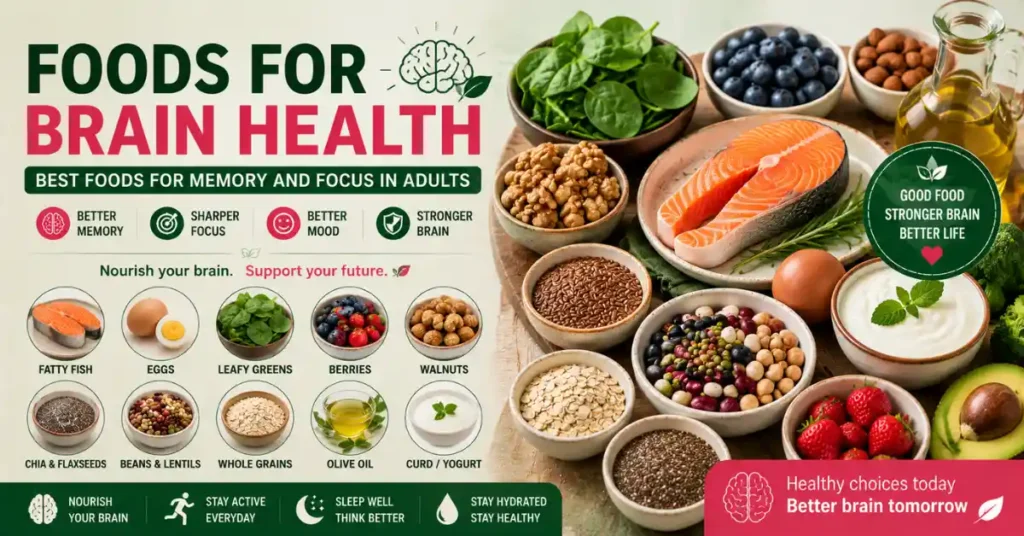
Some of the most useful choices include:
- Fatty fish such as salmon, sardines and mackerel
- Eggs
- Leafy green vegetables
- Berries and other colorful fruits
- Walnuts and other nuts
- Chia and flaxseeds
- Beans, lentils and chickpeas
- Whole grains
- Extra-virgin olive oil and other unsaturated fats
- Plain curd and other nutritious dairy foods
The important point is not to eat every food on this list every day. Variety matters because different foods provide different nutrients.
1. Fatty Fish: A Source of Brain-Supportive Omega-3 Fats
Fatty fish is one of the most frequently studied food groups in relation to brain and cardiovascular health.
Salmon, sardines, trout and mackerel provide long-chain omega-3 fatty acids, including DHA and EPA. DHA is an important structural component of cell membranes and is particularly abundant in the brain.
Research continues to investigate how omega-3 intake and fish consumption relate to cognitive health. However, it would be misleading to say that eating fish prevents Alzheimer’s disease or memory loss. Evidence is more complex, and a healthy overall dietary pattern matters more than one food.
For Indian adults who eat fish, grilled, baked, steamed or lightly cooked fish can be an easy addition to lunch or dinner.
If you do not eat fish, plant foods such as walnuts, chia seeds and flaxseeds provide ALA, another type of omega-3 fatty acid. Your individual needs can determine whether additional sources or supplements are appropriate.
2. Eggs: Protein and Choline for Normal Brain Function
Eggs are an affordable and versatile source of high-quality protein and several important nutrients.
One nutrient that makes eggs particularly interesting from a brain-health perspective is choline. Choline is needed for normal cell structure, nervous-system function and the production of acetylcholine, a neurotransmitter involved in memory and other functions.
Eggs should not be promoted as a guaranteed “memory booster.” Instead, think of them as one nutritious component of a balanced diet.
A vegetable omelette, boiled eggs with whole-grain toast or eggs added to a balanced breakfast can provide protein while helping you avoid a breakfast dominated by refined carbohydrates and added sugar.
3. Leafy Green Vegetables for a Nutrient-Dense Diet
Spinach, methi, mustard greens, amaranth leaves, kale and other leafy vegetables are excellent foods to include regularly.
They provide fiber, folate, vitamin K, carotenoids and other plant compounds. Leafy greens are also emphasized in healthy dietary patterns that have been studied in relation to cognitive health.
The advantage for Indian households is that leafy vegetables already fit naturally into many traditional meals.
You can add them to dal, sabzi, soups, cheela, paratha fillings or other home-cooked dishes.
Instead of asking, “Which single vegetable is best for the brain?” a better question is:
How can I eat a greater variety of vegetables throughout the week?
That approach is more realistic and nutritionally useful.
4. Berries and Colorful Fruits for Brain-Supportive Plant Compounds
Blueberries, strawberries and other berries contain flavonoids and other naturally occurring plant compounds that have been investigated for their potential relationship with cognitive health.
But you do not need to buy expensive imported berries to have a healthy diet.
The bigger nutritional principle is to include a variety of fruits in appropriate portions.
Depending on availability and individual needs, adults can include fruits such as apples, oranges, guava, pomegranate, papaya, berries and other seasonal options.
Whole fruit is generally preferable to fruit juice because it retains fiber and tends to be more filling.
A practical breakfast could combine plain curd with fruit, nuts and seeds.
5. Walnuts and Nuts for Healthy Fats, Protein and Fiber
Nuts can be a convenient addition to a brain-supportive diet.
Walnuts provide ALA omega-3 fatty acids along with protein, fiber, minerals and unsaturated fats. Almonds and pistachios can also contribute healthy fats, protein and other nutrients.
A small serving of unsalted nuts can make a useful snack or topping for oats, curd or salads.
However, nuts are energy-dense. More is not necessarily better.
Portion size matters, especially for adults who are managing body weight or metabolic health.
Want to Support Better Memory and Brain Health Naturally?
The right foods can provide essential nutrients that support brain function, memory, focus, and overall cognitive health. Discover practical nutrition strategies and brain healthy foods that can easily be included in your daily diet, with expert guidance tailored to your health and lifestyle goals.
Get Your Personalized Nutrition Consultation6. Chia and Flaxseeds for Plant-Based Omega-3
Chia seeds and ground flaxseeds are useful options for people following vegetarian or plant-forward diets.
They provide ALA omega-3 fatty acids and fiber and can easily be added to everyday foods.
Try adding a small amount of ground flaxseed or chia seeds to oats, curd, smoothies or homemade meals.
Remember that plant-based ALA is not identical to the DHA and EPA found in fatty fish. The body can convert ALA into DHA and EPA, but the conversion is limited.
Therefore, vegetarian adults who are concerned about omega-3 intake may benefit from individualized nutrition guidance rather than assuming that any single seed completely replaces fish.
7. Dal, Beans and Chickpeas for Fiber and Plant Protein
One of the easiest ways to make an Indian diet more brain-supportive is to use the foods that are already part of traditional meals.
Dal, chana, rajma, lobia, moong and other legumes provide plant protein, fiber, vitamins and minerals.
They also help create more balanced meals when combined with vegetables and appropriate portions of whole grains or other carbohydrate sources.
For example, a meal of dal, vegetables, roti and curd can be much more nutritionally balanced than a meal built mainly around refined carbohydrates.
Healthy eating does not always require unfamiliar foods. Sometimes it means improving the balance of the foods already in your kitchen.
8. Whole Grains for Fiber and Balanced Energy
Oats, barley, brown rice and whole-grain wheat products can provide more fiber and nutrients than highly refined grain products.
Whole grains can be combined with protein, vegetables and healthy fats to create balanced meals.
For example, oats can be paired with nuts, seeds, fruit and unsweetened curd. A traditional lunch can include whole-grain roti with dal and vegetables.
The goal is not to completely eliminate carbohydrates.
The brain needs glucose for energy. The focus should instead be on choosing nutritious carbohydrate sources and combining them with protein, fiber and healthy fats.
9. Healthy Unsaturated Fats
Healthy fats can be an important part of an overall balanced eating pattern.
Olive oil is a major component of Mediterranean-style diets, while Indian households may use a variety of traditional cooking oils.
Rather than believing that one oil is a magical “brain food,” focus on the bigger picture: choose appropriate amounts of unsaturated fats and avoid making heavily fried and highly processed foods a regular part of your diet.
Nuts, seeds, fish and other whole foods can also contribute healthy fats.
10. Plain Curd and Other Nutritious Dairy Foods
Plain curd can provide protein, calcium and other nutrients.
It can also be paired with fruit, nuts and seeds to create a convenient snack or breakfast.
Research into the relationship between the gut and brain is growing, but it is still too early to claim that probiotics or fermented foods can directly prevent memory loss or neurological disease.
For everyday nutrition, the more useful approach is to include nutritious foods that contribute to an overall varied diet.
Which Nutrients Are Important for Brain Health?
There is no single nutrient responsible for keeping your brain healthy.
A balanced diet provides many nutrients involved in normal neurological function, including omega-3 fatty acids, choline, folate, vitamin B12, vitamin D, iron, magnesium, zinc and antioxidants.
This does not mean that taking high-dose supplements will make your memory better.
For example, vitamin B12 is essential for normal neurological function, but taking additional B12 does not automatically improve memory in someone who already has adequate levels.
The same principle applies to many other nutrients.
More is not always better. Adequacy matters.
If you have a restrictive diet, digestive condition, nutritional deficiency or another health concern, individualized assessment can help determine whether supplementation is appropriate.
What Foods Help Memory and Concentration?
There is no single food that can instantly improve memory or concentration.
Instead, a balanced diet containing protein, healthy fats, vegetables, fruits, whole grains and other nutrient-dense foods can support the body’s nutritional needs.
For better concentration during the day, meal balance may also matter.
A breakfast containing protein, fiber and healthy fats may be more satisfying than a breakfast based mainly on sugary foods.
For example, eggs with vegetables and whole-grain toast, or oats with curd, nuts, seeds and fruit, can provide a more balanced combination of nutrients.
Your concentration is also affected by sleep, hydration, stress and physical activity, so nutrition should be viewed as one part of the picture.
Want to Support Better Memory and Brain Health Naturally?
The right foods can provide essential nutrients that support brain function, memory, focus, and overall cognitive health. Discover practical nutrition strategies and brain healthy foods that can easily be included in your daily diet, with expert guidance tailored to your health and lifestyle goals.
Get Your Personalized Nutrition ConsultationWhat Is the Best Diet for Brain Health?
There is no single diet that is guaranteed to protect everyone’s memory.
However, Mediterranean-style and MIND-style dietary patterns have received considerable attention in research on cognitive health.
The MIND diet combines aspects of Mediterranean and DASH-style eating and emphasizes foods such as leafy green vegetables, other vegetables, berries, whole grains, beans, nuts and fish.
These patterns have been associated with better cognitive outcomes in observational research, although research has not established that following a particular diet guarantees prevention of dementia.
The bigger lesson is valuable:
A brain-supportive diet is a pattern, not a plate of one “superfood.”
Foods to Limit for Better Brain Health
Adding healthy foods is only one side of the equation.
It is also worth reducing your reliance on foods that provide a lot of calories but relatively few nutrients.
These may include:
- Sugar-sweetened beverages
- Highly processed snacks
- Excessive added sugar
- Frequently fried foods
- Processed meats
- Foods high in sodium
- Excessive alcohol
- Highly refined carbohydrate-heavy meals
You do not have to completely eliminate your favorite foods.
A sustainable eating pattern allows occasional treats while keeping nutrient-dense foods at the center of most meals.
Can Foods Prevent Memory Loss or Dementia?
No food can guarantee protection against memory loss, Alzheimer’s disease or dementia.
This distinction is important because online nutrition content often turns preliminary research into exaggerated promises.
Healthy eating may contribute to better cardiovascular and metabolic health, and these factors are relevant to brain health. However, cognitive health is influenced by multiple factors, including age, genetics, physical activity, sleep, blood pressure, blood sugar, cholesterol, smoking, alcohol use and other health conditions.
Therefore, the goal should be to support overall health rather than search for a miracle food.
Can Brain Health Be Improved Through Diet Alone?
Diet is important, but it is only one part of brain health.
Adults should also pay attention to:
Sleep
Consistent, good-quality sleep supports attention, memory and overall health.
Physical Activity
Regular physical activity supports cardiovascular health and may benefit brain health.
Blood Pressure and Blood Sugar
Keeping metabolic and cardiovascular risk factors under control is important for long-term health.
Stress Management
Long-term stress can affect sleep, mood, concentration and overall wellbeing.
Mental and Social Activity
Learning, reading, meaningful social interaction and mentally stimulating activities can complement a healthy lifestyle.
The strongest approach is therefore a lifestyle that supports the brain from several directions rather than relying entirely on food.
A Simple Indian Meal Plan Using Foods for Brain Health
You do not need an expensive or complicated diet to eat for brain health.
Breakfast
Vegetable omelette with whole-grain toast and a portion of fruit.
Vegetarian alternative: Oats with plain curd, chia or flaxseed, nuts and fruit.
Mid-Morning
A seasonal fruit or plain curd.
Lunch
Dal or chickpeas with vegetables, roti or another suitable whole-grain option, and curd.
Evening Snack
A small portion of unsalted nuts with fruit.
Dinner
Fish with vegetables and a suitable carbohydrate portion.
Vegetarian alternative: Paneer, tofu or dal with mixed vegetables.
Before Bed
If you are genuinely hungry, a suitable light option can be chosen according to your individual nutritional needs.
The exact portion sizes should not be identical for every adult. Calorie requirements, activity levels, body composition, health conditions and goals all differ.
How to Add More Foods for Brain Health to Your Everyday Diet
You do not have to completely change your diet overnight.
Start with small changes.
Add one extra serving of vegetables to your lunch.
Keep unsalted nuts available instead of relying on packaged snacks.
Add seeds to curd or oats.
Include dal, beans or another protein source regularly.
Choose whole fruit instead of juice more often.
Include fish if it fits your diet.
Reduce sugary drinks.
Make highly processed snacks occasional rather than everyday foods.
These changes may appear simple, but consistency is more important than following a complicated diet for a few days.
When Should You Speak With a Nutrition Professional?
General nutrition advice is useful, but your nutritional requirements may be different from someone else’s.
Personalized guidance can be particularly useful if you are:
- Experiencing persistent changes in appetite or eating habits
- Following a vegetarian or vegan diet
- Managing diabetes or another metabolic condition
- Trying to manage your weight
- Dealing with nutritional deficiencies
- Following a restrictive diet
- Unsure how to create balanced meals
- Looking for a sustainable diet that fits your lifestyle
A qualified nutrition professional can help translate general recommendations into meals that suit your preferences, routine and nutritional requirements.
How NutriDate With Priyanka Can Help
At NutriDate With Priyanka, nutrition is approached as a personalized process rather than a collection of generic food lists.
The goal is not simply to tell you to eat “10 brain foods.”
It is to understand your lifestyle, eating preferences, nutritional needs and health goals and then develop practical strategies that you can realistically follow.
For adults who want to improve their overall eating pattern, support healthy aging or build a more balanced lifestyle, personalized nutrition guidance can make healthy eating easier to maintain.
The Bottom Line on Foods for Brain Health
The best approach to brain health is not to search for one magical food.
Build your meals around a variety of nutrient-dense foods such as vegetables, fruits, legumes, whole grains, nuts, seeds, eggs, fish or appropriate vegetarian protein sources.
Keep highly processed foods and excess added sugar in moderation, stay physically active, sleep well and pay attention to conditions such as high blood pressure and diabetes.
Most importantly, make your eating pattern realistic enough to follow consistently.
Healthy brain nutrition is not about perfection. It is about the quality of your overall diet, the consistency of your habits and the individual choices that work for your body and lifestyle.
For personalized nutrition guidance, NutriDate With Priyanka can help you turn general healthy-eating principles into a practical plan suited to your individual needs.
Want to Support Better Memory and Brain Health Naturally?
The right foods can provide essential nutrients that support brain function, memory, focus, and overall cognitive health. Discover practical nutrition strategies and brain healthy foods that can easily be included in your daily diet, with expert guidance tailored to your health and lifestyle goals.
Get Your Personalized Nutrition ConsultationFrequently Asked Questions
Some of the best foods for brain health include fatty fish, eggs, leafy green vegetables, berries, nuts, seeds, beans, lentils, whole grains and other nutrient-dense foods. The overall dietary pattern is more important than relying on one particular food.
Foods such as fatty fish, eggs, leafy greens, nuts, seeds, berries, whole grains and legumes can contribute nutrients needed for normal brain function. However, no food can guarantee better memory or concentration on its own.
Walnuts provide ALA omega-3 fatty acids, healthy fats, fiber and several micronutrients. They can be a nutritious addition to a balanced diet, although they should be eaten in appropriate portions because they are calorie-dense.
Yes. An Indian diet can support brain health when it includes a variety of vegetables, fruits, dal, beans, nuts, seeds, whole grains, suitable protein sources and healthy fats while limiting excessive added sugar and highly processed foods.
No diet or individual food has been proven to guarantee prevention of dementia. Research suggests that healthy dietary patterns may be associated with better cognitive health, but brain health depends on many factors beyond diet.