How to Read Food Labels: Decode Nutrition Facts and Health Claims
Walk into a supermarket today and you will find food packages covered with words such as “healthy”, “natural”, “multigrain”, “high protein”, “no added sugar” and “rich in fibre”. These claims can make a product appear like a smart choice before you have even looked at what is actually inside it.
But a food package tells you much more than what appears on the front.
The nutrition facts panel, ingredients list, serving size and different claims on the package can reveal a very different picture. Learning how to read food labels can therefore help you make more informed decisions without having to completely avoid packaged foods.
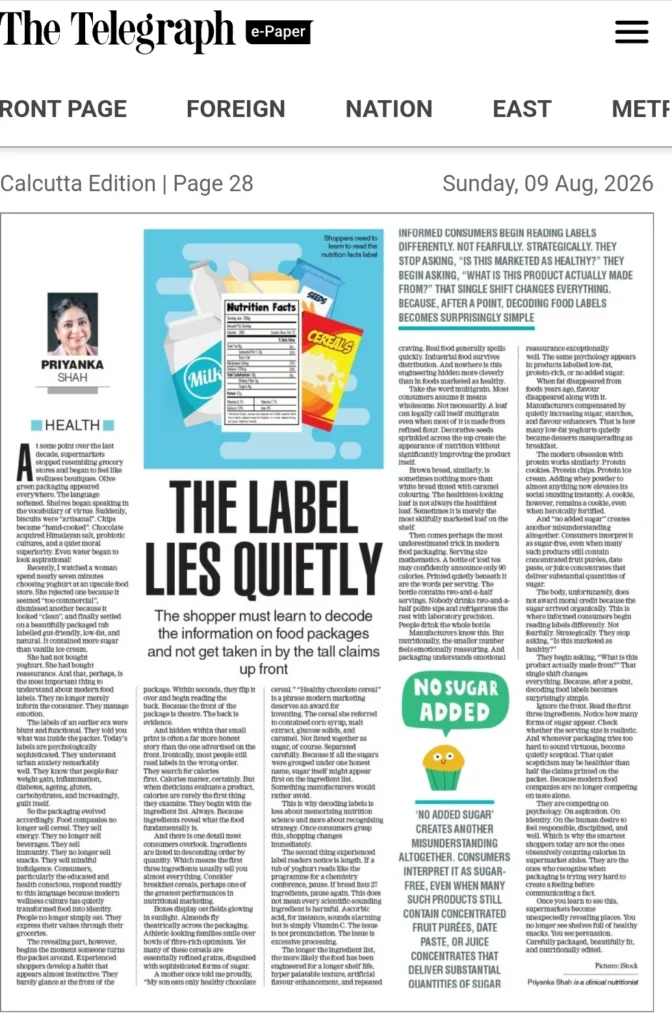
I was recently featured in The Telegraph for a discussion around this very issue, focusing on why consumers need to look beyond prominent claims and understand what food labels are actually telling them.
The goal is not to make grocery shopping complicated. It is to make you a more informed consumer.
Why Reading Food Labels Matters
Food packaging is designed to communicate quickly. When you see “multigrain”, “protein-rich” or “no added sugar”, your brain may immediately associate the product with better health.
However, a single claim does not describe the entire nutritional profile of a food.
A product can contain whole grains and still be high in sugar. A product labelled “no added sugar” can still contain naturally occurring or concentrated sugars. A cereal marketed as healthy may contain several sweetening ingredients.
This is why the most important question is not simply:
“Is this product marketed as healthy?”
Instead, ask:
“What is this product actually made from?”
That small change in thinking can completely change the way you shop.
Start With the Ingredients List
If you want to understand a packaged food, the ingredients list is one of the best places to start.
Ingredients are generally listed in descending order by weight. This means the ingredients present in larger quantities appear earlier in the list.
For example, if sugar, refined flour or another highly refined ingredient appears near the beginning, it deserves your attention.
This is particularly useful when the front of the package highlights something else.
A cereal may prominently display whole grains, while the ingredients list gives you a better idea of how much of the product is actually based on those ingredients.
The same principle applies to bread, biscuits, breakfast cereals, snack bars, sauces and many other packaged foods.
Look Beyond the First Ingredient
Checking only the first ingredient is not enough.
Manufacturers can use different forms of sugar or similar ingredients in a product. Therefore, it is useful to read the complete ingredient list rather than searching for just one word.
Ingredients can also appear under different names. Understanding the overall list gives you a better picture of what you are purchasing.
Don’t Let “Multigrain” Automatically Mean Healthy
“Multigrain” sounds nutritious, but the word itself does not necessarily mean that a product is made primarily from whole grains.
A multigrain product may contain several different grains while still being made largely from refined ingredients.
Instead of relying only on the word “multigrain”, check the ingredients list and look for whole grains or whole-grain ingredients near the beginning.
This is an important distinction because multigrain and whole grain are not automatically the same thing.
The same approach can be applied to bread. Words such as “brown”, “multigrain” or “healthy” should encourage you to check the label rather than automatically convince you that the product is the better option.
Understand the Serving Size
One of the most commonly overlooked parts of a nutrition label is the serving size.
The numbers shown for calories, sugar, fat, protein and other nutrients may be based on one serving rather than the entire package.
Suppose a packet contains two servings, but you eat the entire packet. If the nutrition information is provided per serving, your actual intake may be roughly twice the listed amount.
This is why you should always ask:
How much is one serving, and how much am I actually eating?
Serving sizes become particularly important for breakfast cereals, snacks, instant foods, desserts and packaged beverages where it is easy to consume more than the stated serving.
Don’t Look at Calories Alone
Calories matter, but they are not the complete story.
Two products can contain similar calories while offering very different nutritional value.
One may provide more protein and fibre, while another may contain more added sugars or saturated fat.
When comparing products, look at the broader nutritional picture rather than choosing solely on the lowest calorie number.
Depending on your individual needs, you may want to pay attention to nutrients such as protein, fibre, total fat, saturated fat, sodium and sugars.
The right choice can also vary depending on your health goals, dietary pattern and overall diet.
What Does “No Added Sugar” Actually Mean?
“No added sugar” is another phrase that can easily be misunderstood.
It generally means that additional sugars have not been added during processing. It does not necessarily mean that the product contains no sugar or that it is automatically low in carbohydrates.
For example, products made with concentrated fruit ingredients, fruit purees or fruit juices can still contribute significant amounts of sugar.
This is why reading the nutrition information and ingredients list is important even when the front of the package says “no added sugar”.
No Added Sugar Is Not the Same as Sugar-Free
These terms should not be treated as interchangeable.
A “no added sugar” product can still contain naturally occurring sugars or sugars from its ingredients.
“Low sugar”, “sugar-free” and “no added sugar” can have different meanings depending on the product and applicable food-label regulations.
The safest habit is to look at the actual nutrition information rather than making a health decision based on a single front-of-pack claim.
“High Protein” Does Not Tell You Everything
Protein has become one of the biggest selling points in the packaged food industry.
Protein bars, cereals, drinks, snacks and even desserts may now prominently display protein claims.
But a high-protein claim should be considered in context.
Look at how much protein the product actually provides per serving. Then consider what else comes with it.
A product may provide protein but also contain substantial amounts of sugar, saturated fat or sodium. That does not automatically make it a bad food, but it means the protein claim should not be the only factor influencing your decision.
The better question is:
“What does this product provide overall?”
“Healthy” Is Not a Nutrition Category
One of the biggest mistakes shoppers make is treating marketing language as nutritional information.
Words such as “healthy”, “natural”, “wholesome”, “guilt-free” or “smart choice” can influence how we perceive a product.
But these words do not replace the nutrition facts panel or ingredients list.
A product can contain one beneficial ingredient and still have other nutritional considerations worth noticing.
This does not mean every product making a health claim is unhealthy. It simply means that the claim should be the beginning of your evaluation, not the end.
How to Read a Nutrition Facts Label Quickly
You do not need to spend ten minutes studying every packet in the supermarket.
A simple routine can make label reading much easier.
Step 1: Check the Serving Size
First, find out what quantity the nutrition information refers to.
Step 2: Look at Calories
Use calories as one part of the picture, not the entire picture.
Step 3: Check Protein and Fibre
These can be particularly useful when comparing breakfast foods, snacks and meal options.
Step 4: Check Sugars
Look at the sugar information and then review the ingredients list to understand where sweetness may be coming from.
Step 5: Look at Saturated Fat and Sodium
Depending on your individual dietary needs, these can be important nutrients to monitor.
Step 6: Read the Ingredients
Finally, check what the product is actually made from and which ingredients appear near the beginning of the list.
This process becomes much faster with practice.
The Psychology Behind Food Labels
There is another reason food labels can be confusing: we tend to read packages emotionally before reading them nutritionally.
A bright package with images of grains, fruits or fitness-related messaging can create an immediate perception that a product is good for us.
Once that perception is created, we may pay less attention to the less prominent information.
This is why becoming an informed shopper is more useful than memorising a list of “good” and “bad” foods.
When you start reading labels strategically, you stop asking:
“Is this product healthy?”
You start asking:
“What is this product made of, how much am I eating, and does it fit into my dietary needs?”
That is a much more useful way to approach food choices.
Common Food Label Mistakes to Avoid
Choosing a Product Because of One Claim
A “high protein” or “multigrain” claim does not describe the complete product.
Ignoring the Ingredients List
The front of the packet is designed to attract attention. The ingredients list can provide a much more detailed picture.
Confusing Portion Size With Package Size
Always check whether the nutrition information applies to the entire packet or only one serving.
Assuming “No Added Sugar” Means Sugar-Free
The absence of added sugar does not automatically mean that a product contains no sugar.
Treating Brown Colour as Proof of Whole Grains
Colour alone cannot tell you whether a product is genuinely whole grain.
How a Dietitian Can Help You Understand Food Labels
For someone trying to improve their diet, reading every label can initially feel overwhelming.
A dietitian can help you understand which nutritional factors matter most for your individual goals. Someone focused on weight management may need a different approach from someone managing blood sugar, digestive concerns, sports nutrition or another specific dietary requirement.
Instead of following generic internet rules about what to buy and what to avoid, personalised nutrition guidance can help you understand how different foods fit into your overall eating pattern.
At NutriDate with Priyanka, the focus is on making nutrition practical, understandable and sustainable rather than unnecessarily restrictive.
About the Feature
Priyanka Shah was recently featured in The Telegraph’s Calcutta Edition on 9 August 2026 in a health feature focused on helping consumers understand food labels and look beyond prominent packaging claims.
You can also add a small “As Featured In The Telegraph” section on the website with the original newspaper clipping and a link to the published e-paper article:
Read the original article in The Telegraph e-paper
Frequently Asked Questions
Start by checking the serving size, calories, protein, fibre, sugars, saturated fat and sodium. Then read the ingredients list to understand what the product is actually made from.
Not necessarily. “Multigrain” means that multiple grains are used, but it does not automatically mean that the product is primarily made from whole grains. Check the ingredients list.
No. A product can have no added sugar and still contain naturally occurring sugars or sugars contributed by ingredients such as fruit preparations or concentrated juices.
Not necessarily. Calories are only one part of nutrition. Protein, fibre, fats, sugars, sodium and the overall quality of ingredients can also matter.
There is no single section that tells you everything. A good starting point is to combine the serving size, nutrition information and ingredients list rather than relying on one front-of-pack claim.