How to Read Nutrition Labels: A Dietitian’s Complete Guide
When you walk through the supermarket, hundreds of packaged foods compete for your attention with claims like “High Protein,” “Low Fat,” “Sugar-Free,” “Natural,” and “No Added Preservatives.” These labels are designed to encourage purchases, but they do not always reflect the overall nutritional quality of the product.
Many people assume that if a food carries a health claim, it must be good for them. In reality, some products contain high amounts of added sugar, sodium, unhealthy fats, or refined ingredients despite looking healthy on the front of the package.
Learning how to read nutrition labels is one of the most practical skills you can develop for making healthier food choices. Whether your goal is weight loss, diabetes management, PCOS care, heart health, or simply improving your family’s eating habits, understanding food labels helps you choose foods based on facts rather than marketing.
Confused by Nutrition Labels on Packaged Foods?
Learning to read nutrition labels can help you make healthier food choices, avoid excess sugar, sodium, unhealthy fats, and identify ultra processed foods. Get expert guidance from a qualified dietitian to understand food labels and build a balanced diet that supports your long-term health.
Book Your Personalized Nutrition ConsultationHow to Read Nutrition Labels
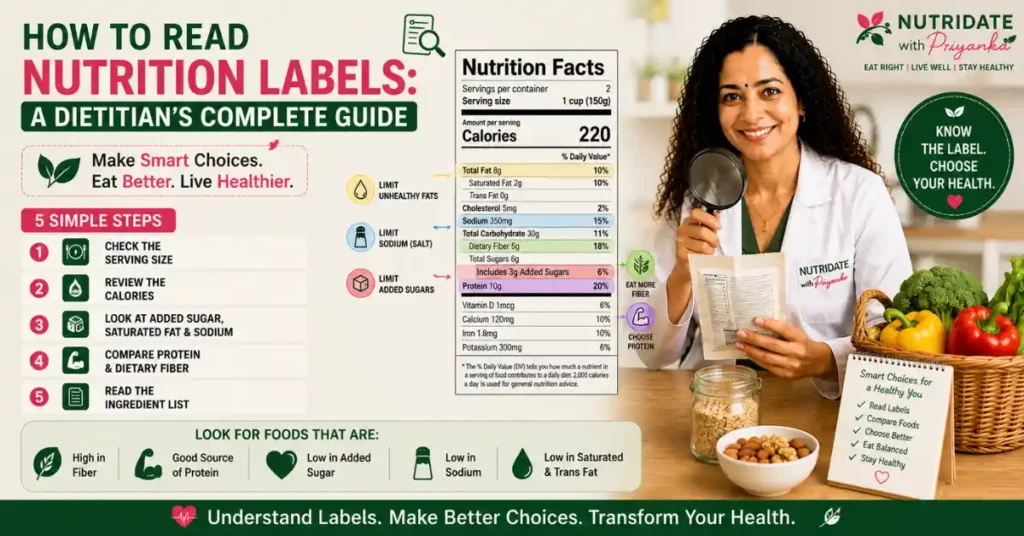
If you want to know how to read nutrition labels, follow these five essential steps:
- Check the serving size.
- Review the calories per serving.
- Look at added sugar, saturated fat, and sodium.
- Compare the amount of protein and dietary fiber.
- Read the ingredient list before making your decision.
Following these simple steps allows you to compare products accurately and choose foods that support your health goals.
Why Is It Important to Read Nutrition Labels?
Nutrition labels are designed to provide transparent information about the food you are buying. They tell you how much energy, protein, fat, carbohydrates, sugar, fiber, vitamins, and minerals are present in a serving.
Unfortunately, many shoppers focus only on attractive packaging or front-of-pack claims without checking the Nutrition Facts panel. This often leads to buying products that appear healthy but contain ingredients that should be consumed in moderation.
Reading nutrition labels helps you:
- Make healthier grocery shopping decisions.
- Control calorie intake.
- Reduce added sugar consumption.
- Limit excess sodium and unhealthy fats.
- Compare similar products more effectively.
- Support long-term health and disease prevention.
Always Start with the Serving Size
The serving size is the foundation of the Nutrition Facts label because every nutritional value is calculated based on that amount.
For example, a packet of biscuits may list 120 calories per serving, but if the packet contains three servings and you eat the entire pack, you have actually consumed 360 calories.
The same applies to sugar, sodium, carbohydrates, and fat.
Before comparing two products, make sure their serving sizes are similar. Comparing different serving sizes can lead to inaccurate conclusions.
Calories Show Energy, Not Nutrition Quality
Calories indicate how much energy a food provides, but they do not tell you whether the food is nutritious.
Two foods may each contain 200 calories, yet one could provide protein, fiber, vitamins, and healthy fats while the other consists mainly of refined flour and added sugar.
Instead of focusing only on calorie numbers, consider the nutritional value of those calories.
Ask yourself:
- Does this food provide enough protein?
- Is it rich in dietary fiber?
- Does it contain excessive added sugar?
- Will it keep me full for longer?
These questions are often more valuable than calorie counting alone.
Understand Carbohydrates and Added Sugar
The carbohydrate section includes both naturally occurring carbohydrates and added sugars.
Naturally occurring sugars found in milk and whole fruits are different from sugars added during food processing.
High intake of added sugar has been linked with obesity, type 2 diabetes, fatty liver disease, and dental problems.
Manufacturers may use different names for added sugar, including:
- Glucose
- Fructose
- Dextrose
- Maltose
- Sucrose
- Corn syrup
- Rice syrup
- Malt extract
- Cane sugar
- Fruit juice concentrate
If several forms of sugar appear in the ingredient list, the product may contain more added sugar than you realize.
Check the Amount of Protein
Protein plays an important role in maintaining muscles, supporting recovery, and improving satiety.
When comparing similar products such as breakfast cereals, yogurt, or snack bars, choosing the option with higher protein can help you stay satisfied for longer.
However, remember that a product promoted as “High Protein” may also contain high amounts of sodium or saturated fat. Always evaluate the complete nutrition label instead of focusing on a single nutrient.
Why Dietary Fiber Matters
Dietary fiber supports healthy digestion, promotes fullness, and helps maintain stable blood sugar levels.
Many highly processed foods contain very little fiber because the natural grain structure has been removed during processing.
Choosing foods with higher fiber content can improve digestive health and reduce frequent hunger between meals.
Whole grains, oats, legumes, fruits, vegetables, nuts, and seeds are naturally good sources of dietary fiber.
Confused by Nutrition Labels on Packaged Foods?
Learning to read nutrition labels can help you make healthier food choices, avoid excess sugar, sodium, unhealthy fats, and identify ultra processed foods. Get expert guidance from a qualified dietitian to understand food labels and build a balanced diet that supports your long-term health.
Book Your Personalized Nutrition ConsultationWatch Your Sodium Intake
Sodium is an essential mineral, but consuming excessive amounts over time may contribute to high blood pressure and cardiovascular disease.
Many packaged foods contain hidden sodium, including:
- Instant noodles
- Chips
- Ready-to-eat meals
- Frozen foods
- Sauces
- Soups
- Processed meats
Comparing similar products can help you identify options with lower sodium content without sacrificing convenience.
Read the Ingredient List Carefully
The ingredient list often reveals information that nutrition numbers alone cannot.
Ingredients are listed in descending order by weight, meaning the ingredient present in the largest quantity appears first.
If the first few ingredients include refined flour, sugar, palm oil, or hydrogenated fats, the product is likely more processed.
A shorter ingredient list containing recognizable foods generally indicates a less processed product.
Reading both the Nutrition Facts panel and the ingredient list provides a much clearer understanding of what you are eating.
What Does Percent Daily Value Mean?
The Percent Daily Value helps you understand whether a nutrient is present in a low or high amount.
As a simple guide:
- Five percent Daily Value or less is considered low.
- Twenty percent Daily Value or more is considered high.
Try to choose foods that are lower in saturated fat, sodium, and added sugars while selecting products higher in fiber, calcium, iron, and potassium.
Common Food Label Claims That Can Be Misleading
Food companies often use marketing terms that attract attention but do not always reflect the overall nutritional quality.
Examples include:
- Low Fat
- Sugar-Free
- Natural
- Multigrain
- High Protein
- Organic
These claims should never replace reading the complete Nutrition Facts label and ingredient list.
Compare Similar Products Before Buying
Comparing products is one of the easiest ways to improve your diet without making major lifestyle changes.
When choosing between two products, compare:
- Serving size
- Calories
- Added sugar
- Sodium
- Saturated fat
- Protein
- Dietary fiber
- Ingredient list
Making informed comparisons allows you to choose the better option based on nutrition rather than advertising.
Common Mistakes People Make While Reading Nutrition Labels
Many shoppers unknowingly make mistakes that affect their food choices.
Some of the most common include:
- Ignoring serving size.
- Looking only at calories.
- Not checking added sugar.
- Skipping the ingredient list.
- Trusting front-of-pack marketing claims.
- Comparing products with different serving sizes.
Avoiding these mistakes can significantly improve the quality of your daily diet.
A Dietitian’s Grocery Shopping Checklist
Before placing any packaged food into your shopping cart, ask yourself:
- Is the serving size realistic?
- Does it contain excessive added sugar?
- Is the sodium level reasonable?
- Does it provide enough protein and fiber?
- Are the ingredients simple and recognizable?
- Would I choose to eat this regularly as part of a balanced diet?
Answering these questions can help you make more informed food choices every time you shop.
Confused by Nutrition Labels on Packaged Foods?
Learning to read nutrition labels can help you make healthier food choices, avoid excess sugar, sodium, unhealthy fats, and identify ultra processed foods. Get expert guidance from a qualified dietitian to understand food labels and build a balanced diet that supports your long-term health.
Book Your Personalized Nutrition ConsultationFrequently Asked Questions
Start with the serving size, then review calories, protein, carbohydrates, added sugar, sodium, saturated fat, dietary fiber, and finally the ingredient list before deciding whether to buy the product.
The serving size should always be checked first because every nutritional value is based on that amount.
No. Sugar-free products may still contain artificial sweeteners, refined carbohydrates, unhealthy fats, or high sodium levels. Always review the complete Nutrition Facts panel.
The ingredient list tells you exactly what the product contains and helps identify highly processed ingredients, hidden sugars, and unhealthy fats.
Yes. Understanding how to read nutrition labels helps you control portion sizes, reduce added sugar intake, compare healthier products, and make better food choices that support sustainable weight management.